The Evening Wind-Down Routine: A 45-Minute Off-Ramp
The last hour of your day decides how easy it is to fall asleep. A three-block wind-down structure, screen rules that respect real habits, and the four ways routines like this usually fail.
By the Wellspring Daily editorial team · How we check our guides
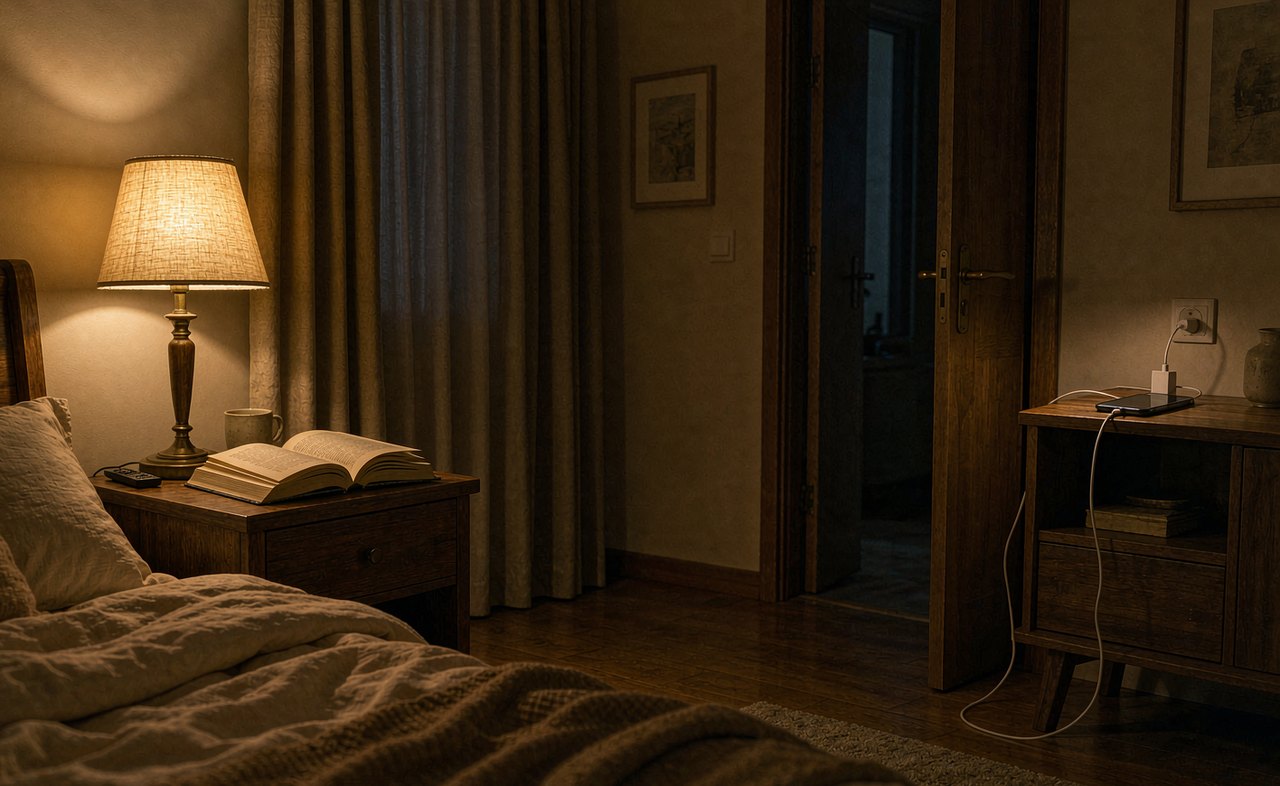
Most sleep advice concentrates on the morning - light, alarm times, caffeine cutoffs. But the last hour of your day quietly decides how easy it is to fall asleep, and for many people it is the hour most likely to sabotage everything the morning routine built. An evening wind-down routine is simply a short, repeatable sequence of low-effort actions that tells your body the day is over. It is not about meditating perfectly or buying anything; it is about giving your nervous system a predictable off-ramp instead of switching from work and screens straight to lights out. This guide walks through what a wind-down actually does, a 45-minute structure you can adapt, and the common traps that make routines like this fail.
Why the last hour matters
Your body builds up sleep pressure across the day, and your internal clock starts preparing for sleep hours before bedtime: core body temperature begins to drift downward, and the hormone that signals darkness rises in the evening. The catch is that this preparation is fragile. Bright overhead light, an argument over email, or a last-minute scroll through a heated comment section can each push the "it is still daytime, something is happening" signal back to the top of the queue.
That is why wind-down routines appear in nearly every practical sleep guide: they stack the deck by reducing stimulation in the window when your body is already trying to shift gears. The routine itself is less important than the consistency. A predictable sequence becomes a learned cue - the same way a certain smell can recall a place, finishing the dishes and dimming the lights can start to recall sleep.
Two honest caveats before the how-to. First, a wind-down helps sleep quality and sleep-onset for most people, but it is not a treatment for a sleep disorder. If you regularly sleep a full opportunity and still feel exhausted, or you snore loudly with pauses in breathing, talk to a clinician - those patterns deserve real evaluation, not just better routines. Second, expect gradual gains, not overnight transformation; give any new routine two weeks before judging it.
The 45-minute structure: three blocks
You do not need 45 minutes. You need a sequence short enough to survive a busy evening and long enough to actually downshift. A three-block structure works well because it gives the hour a shape instead of a vague "relax before bed" instruction.
Block 1 - Close the day (about 15 minutes). The goal is to park loose ends so your brain stops chewing on them at 1 a.m. Write tomorrow's top three tasks on paper - not in an app that lights up a screen - and put the paper where you will see it in the morning. Do one small tidying action: dishes in the washer, clothes off the chair. These are deliberately trivial. Their job is to signal completion, not to run a second shift of housework.
Block 2 - Downshift the body (about 20 minutes). Choose one physical activity from this list, not five: a hot shower or bath, five minutes of slow stretches for the neck, hips, and lower back, or simply lying on the floor with your legs elevated while breathing slowly through the nose. A shower is more useful than it sounds: the warm water raises skin temperature, and the afterward cooldown mimics the natural temperature drop your body associates with sleep onset. Keep any stretching gentle - the aim is release, not a workout.
Block 3 - Low-key light and low-key mind (the final 10 to 15 minutes). Dim the lamps to roughly the brightness of a restaurant at closing time - warm bulbs, no overhead ceiling light. Then do something boring on purpose: a paper book, a printed magazine, a guided breathing track at low volume. Boring is the point. Content that is "just interesting enough" to stay engaging is exactly the content that keeps you up.
What to do about screens
The evening screen question is less about blue light than most articles claim, and more about two other things: the light level of a phone at full brightness is enormous compared to a dim lamp, and the content is engineered to be more engaging than a paper book. That is why doomscrolling until 1 a.m. defeats even the best routine, and why "the phone is keeping my brain awake" is a more accurate complaint than "the blue light is."
Practical middle ground that respects real habits:
Set a screen alarm. A repeating alarm labeled "wind-down" one hour before your target bedtime works better than willpower. When it rings, the phone goes to its charger outside arm's reach - a different room if possible, a dresser across the bedroom if not.
If you keep a screen, change the two dials that matter. Turn brightness all the way down and pick genuinely dull content: a familiar show you have seen before at low volume, or an ebook with warm-toned page color. Scrolling feeds does not qualify; the infinite-content design is the problem, not the display.
Handle the "one last check" reflex. The strongest urge arrives right after the alarm. Pre-decide the answer: tomorrow's three tasks are already written on paper, so nothing at 11 p.m. is urgent enough to require you. It sounds almost too simple, but the paper list is what makes it true.
If you share a bed or a small apartment. A wind-down does not require silence or darkness from everyone else. Earplugs or a low-volume fan, a clip-on book light, and a shower as your Block 2 all work around other people's schedules. Adapt the sequence, not the principle.
The most common failure modes (and the fixes)
Routines fail in predictable ways. Knowing the pattern in advance makes the fix trivial.
The too-ambitious routine. A plan with journaling, stretching, meditation, skincare, and reading takes 90 minutes, gets abandoned after four days, and leaves you feeling behind. Fix: cut it to one item per block. A routine you actually do at 80% effort beats a perfect one you skip.
The variable bedtime. A wind-down anchored to "whenever I finish my show" is not a routine. Anchor it to a clock instead: if the alarm is at 10:15 and target sleep is 11:00, the sequence has a spine. Shift-work schedules are the exception - anchor to your own consistent pre-sleep window instead of a fixed clock time.
The weekend collapse. Shifting the whole schedule by three hours on weekends resets much of what the routine built during the week. A compromise most people can sustain: keep the wind-down sequence on weekends but let it run later, within about an hour of the weekday version.
Skipping it "just tonight" under stress. Ironically, the evenings you most want to skip the routine are the ones it helps most. On a bad night, run a two-minute emergency version: write tomorrow's list, lights down, breathe slowly for two minutes. A shorter version still counts, and counting it is what keeps the habit alive.
A sample 45-minute evening, start to finish
Here is the whole structure translated into a real evening, for a target sleep time of 11:00 p.m.:
10:10 - The wind-down alarm rings. Phone goes to the charger in the hallway. Laptop lid closes for the night.
10:12 - Tomorrow's three tasks written on the notepad by the kettle; the mug is rinsed and placed in the dishwasher. Block 1 done in under ten minutes.
10:25 - Warm shower, five minutes longer than usual, lights in the bathroom kept low. Afterward, two minutes of neck and hip stretches on the bedroom floor. Block 2 done.
10:40 - Overhead light off, bedside lamp on. Paper book in hand, no phone within reach. Most nights, drowsiness arrives somewhere between page ten and page thirty - when it does, lights off and done.
11:00 - Target sleep time, usually already asleep or close to it.
Notice that nothing in this evening requires equipment, an app, or more than a few minutes of discipline. The alarm does the enforcement, the paper list does the worry-parking, and the sequence does the rest.
How this fits with the rest of your sleep habits
A wind-down works best as the last layer of a full sleep setup rather than a solo fix. If your bedroom is warm, bright, or noisy, fix that first - our guide to setting up your bedroom for better sleep covers temperature, light, and sound with specific targets. If you wake at 3 a.m. regularly, the wind-down helps but the middle-of-the-night strategy matters too; see how to fall back asleep after waking at night. And if your sleep schedule has drifted so far that a wind-down alone cannot pull it back, our guide to resetting your sleep schedule is the right starting point. For the caffeine side of the equation - when your last coffee actually stops mattering - caffeine and sleep timing has the numbers.
A note on expectations
Give the routine two weeks of mostly-consistent practice before judging it. What most people notice first is not falling asleep faster but falling asleep more calmly - less clock-watching, less mind-racing. That is the nervous system learning the cue, and it is the mechanism by which everything else improves. If after a fair trial sleep problems persist despite good habits and adequate sleep opportunity, that is information too, and a conversation with a healthcare professional is the reasonable next step rather than another app.
This article is for general information only and is not medical advice. It does not diagnose, treat, or replace professional care - if you have a sleep disorder, a health condition, or concerns about your sleep, please consult a qualified clinician.
A note on health advice
This guide shares general wellbeing information based on published guidance and personal testing. It is not medical advice. If you have a condition, are pregnant, or feel pain during any movement, check with a qualified professional before starting.