How to Sit Less at a Desk Job (Practical Breaks)
Eight hours of chair time is a workload problem, not a willpower problem. How activity breaks work, what the research numbers actually say, and a realistic way to build them into a busy day.
By the Wellspring Daily editorial team · How we check our guides
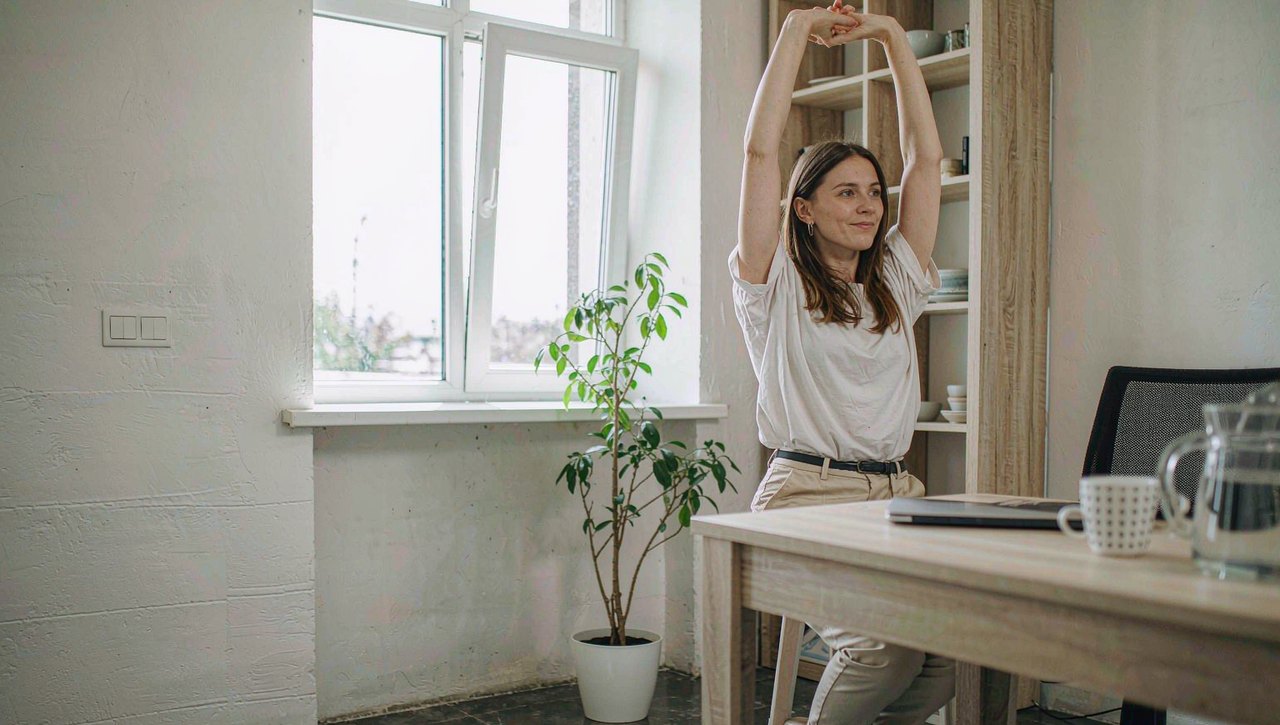
If you work at a computer, you have probably heard that sitting is bad for you, followed by advice that assumes you can simply decide to stand all day. Most desk workers cannot. Meetings, deadlines, and a chair that is right there make eight or more hours of sitting the default. The practical answer is not to eliminate the chair but to break up the stretches of sitting, and the encouraging part is that the breaks do not need to be long or sweaty to matter. This guide explains what counts, what the research numbers actually show, and how to build a break habit that survives a normal working week.
Why uninterrupted sitting is its own problem
For a long time the assumption was that sitting was simply low activity — a zero on the movement scale. Research over the last fifteen years suggests something different: long unbroken sitting has effects that are not fully cancelled by exercising later. Muscles that stay still for hours take up less glucose from the blood, lipoprotein lipase activity in working muscles drops, and circulation in the legs slows. None of this is a reason to panic at your chair, but it explains why the pattern that matters is how long you sit without moving, not just how many total hours the logbook shows.
A frequently cited small study from 2012 (Dunstan and colleagues, published in Diabetes Care) had adults sit for seven hours and found that taking a two-minute light-intensity walking break every twenty minutes blunted post-meal blood glucose spikes by around 24% and insulin spikes by around 23% compared with sitting the whole time. It was a small trial of a single day, so treat the exact percentages as an indication rather than a law — but the shape of the finding has been replicated in larger follow-ups: frequent short breaks change how the body handles a day of sitting, even when the breaks are light.
On the energy side, the arithmetic is humbling and worth knowing so you do not chase phantom calorie burns. A 2018 meta-analysis (Saeidifard and colleagues) found standing burns roughly 88 kcal per hour versus about 80 for sitting — a difference of 6–10 kcal per hour. Standing all afternoon burns approximately the energy of half a biscuit. The benefit of standing desks is comfort and posture variety, not calorie burn; the metabolic payoff comes from actually walking around.
What counts as a break
The threshold for "breaking up" sitting is lower than most people assume. Based on the trials above and similar work:
- Two to three minutes of light movement is enough. Casual walking, climbing a flight of stairs, or a few easy stretches all qualify. You should be able to hold a conversation throughout — this is not a workout.
- Every 30 to 60 minutes is the useful rhythm. The 2012 study used every twenty minutes, which is hard to sustain in real jobs; thirty to sixty is a realistic compromise that keeps the longest unbroken stretches bounded.
- Breaking it up beats compensating. A one-hour lunchtime walk is genuinely good for you, but it does not exempt the other seven hours. The goal is to shorten the longest sits, wherever they fall in the day.
Build the break habit without fighting your calendar
The reason break advice fails is that it adds decisions to a day that is already full of them. Remove the decisions instead:
- Anchor breaks to work events, not the clock. Stand up every time you send a long email, finish a document, or end a call. Work events arrive naturally several times an hour, and unlike a timer, they do not fire mid-sentence.
- Make one recurring movement slot per hour. If you prefer timers, set one that repeats and treat it as advisory — you take the break at the next natural pause rather than dropping everything.
- Move your water supply off your desk. A bottle you refill at a kitchen or water cooler turns hydration into a built-in walk. This is the single most effective passive break generator for most office workers.
- Take at least one call standing or walking. Phone and audio-only calls are free movement time. Headphones plus a corridor loop is a genuine 10-minute break that costs no calendar time.
- Change where small tasks happen. Reading, planning, and thinking tasks tolerate movement far better than typing. Match the task to the posture instead of forcing one posture all day.
If you use a sit-stand desk, vary it: long static standing brings its own aching legs and varicose complaints, so alternating between sitting and standing every 30–60 minutes is the goal, not standing marathons.
A realistic weekday template
- Morning: take the first call of the day standing. Refill water twice before lunch. That is already two or three breaks without a single timer.
- Midday: a 10–15 minute walk after lunch is the single highest-value break available — it lands when post-meal glucose peaks and doubles as a mental reset. Rain or a small office is no excuse: stairwells and hallways work.
- Afternoon: this is where unbroken sitting accumulates. Anchor at least two breaks to work events (after finishing any document, after each meeting) and do two minutes of light movement: stairs, a hallway walk, or standing stretches such as the ones in our desk stretch routine.
- Evening: the commute or the walk to the school gate counts. If you work from home, a ten-minute loop "arriving" and "leaving" the workday creates the boundary that a commute used to provide.
That template produces roughly eight to twelve light breaks a day without making movement the job. It is not dramatic, and that is the point.
What a two-minute break actually looks like
"Move around" is vague enough that people default to doing nothing. Concrete options, roughly in order of effort:
- Stand and do three slow shoulder rolls, ten heel raises, and a 30-second calf stretch. Zero equipment, no leaving the room, and it gets blood moving through the largest idle muscle groups.
- Walk one loop of your space. Around the desk, down the hall, or a lap of the floor. Sixty to ninety seconds at a relaxed pace.
- Climb one flight of stairs, down and back. The highest-effort option, and the most useful if your day has been very light so far.
- Do one real-world task standing. Recycle something, wipe a counter, water a plant, put away a dish. Folding chores into breaks makes the habit nearly free to maintain.
- Take three slow breaths at a window. Not movement in the metabolic sense, but a posture reset and a mental boundary between tasks; on the most stressful days, this is the version that still happens.
Rotate rather than optimizing. The best break is whichever one you will actually take when the moment arrives.
Tools that help (and when they do not)
You do not need to buy anything: your phone's clock app has a repeating timer, and every calendar tool can nudge you hourly. That said, a few tools earn their keep:
- Smartwatch stand or move reminders. Most vibrate once per hour and track whether you stood. Effective for the first weeks; many people then turn the alerts off, so decide whether you are a timer person before relying on one.
- Desktop break software. Free utilities can dim the screen or lock the cursor briefly every 30–60 minutes. Useful for home workers whose days are pure typing blocks.
- A glass, not a bottle. Counter-intuitive, but a small glass that needs frequent refills generates more walks than a two-litre bottle on the desk. If you already refill a bottle religiously, you have your system; otherwise shrink it.
- Meeting boundaries. End calls at :25 or :55 instead of :30/:00 when you control the invite. Those five minutes are the least friction breaks in any office job.
The failure mode to avoid is turning breaks into surveillance. If a forgotten reminder produces guilt rather than movement, the tool is working against the habit — drop back to anchoring breaks to work events for a week and try the timer again later.
If you sit more than eight hours
Some jobs simply pin you down — support shifts, trading floors, long drives. Three adjustments help: keep the longest single sit under one hour even on the worst days; make the breaks you do take genuinely different (walk, do not just lean back); and lean harder on the levers outside work, since a day with an hour of brisk walking and a shorter longest-sit is a very different physiological event from the same hours all motionless. For people who spend most of the day on their feet instead, the same logic runs in reverse — scheduled seated rest breaks matter too.
One caution belongs here. New or persistent pain — in the legs, hips, or back; numbness; or noticeable swelling in one leg — is not a "sit less harder" problem. Circulation and musculoskeletal issues have causes that breaks cannot fix, and those symptoms deserve a proper assessment rather than a blog's advice. General guidance like this article cannot account for individual circumstances, and a qualified healthcare professional is the right stop for anything that hurts, worsens over days, or worries you.
The short version
You do not need to defeat the chair, just shorten the episodes. Two to three minutes of light movement every half hour or so, anchored to work events and water refills rather than timers, changes the shape of a desk day measurably — and the lunchtime walk is the one break worth protecting when everything else fails. Pair the new rhythm with the setup advice in our posture guide, and for the broader picture on daily energy, see why you feel tired all the time. The rest of the movement series lives in the Wellspring Daily index.
This article is general health information, not medical advice. It cannot account for your individual circumstances — if you have a health condition, are recovering from an injury, or experience pain or symptoms when moving, consult a qualified healthcare professional before changing your activity routine.
A note on health advice
This guide shares general wellbeing information based on published guidance and personal testing. It is not medical advice. If you have a condition, are pregnant, or feel pain during any movement, check with a qualified professional before starting.