Hip Flexor Stretches for People Who Sit All Day
Tight hips after a day at the desk are not a character flaw — they are geometry. Why sitting shortens the hip flexors, four stretches that restore the range, and how to fit them into a normal day.
By the Wellspring Daily editorial team · How we check our guides
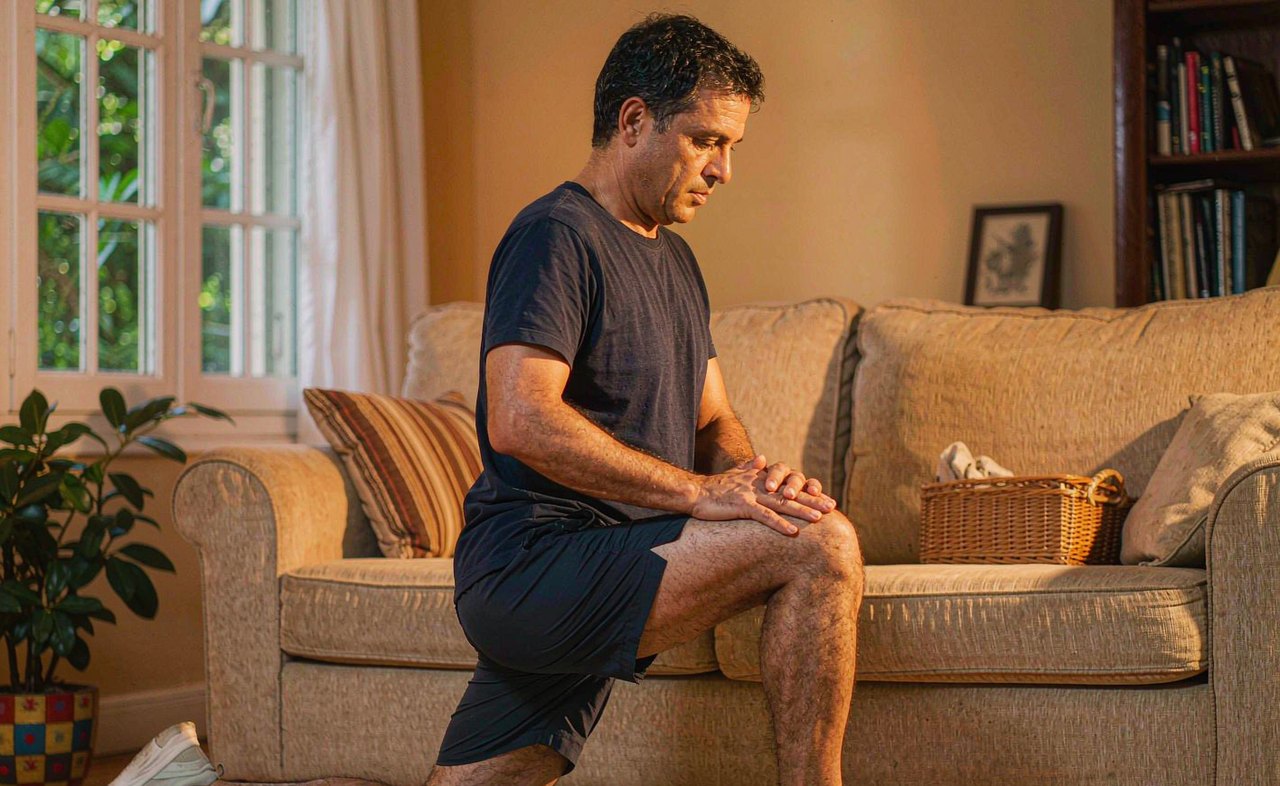
Stand up after a long stretch at the desk and the first few steps often feel like you are wearing someone else's hips: short-strided, stiff across the front, vaguely grumbling. That tightness across the front of the hip is the signature of a day spent sitting, and it is one of the most common physical complaints of desk life. The good news is that the hips respond to simple stretching unusually well — you can feel a difference from a single session, and a lasting one within a couple of weeks of regular work.
This guide explains why sitting tightens the front of the hip in the first place, then walks through four stretches that restore the range, in the order to do them.
Why sitting shortens your hip flexors
The hip flexors are the group of muscles at the front of the hip — the iliopsoas deep in the pelvis, plus the rectus femoris running down the front of the thigh — whose job is to bring your thigh toward your torso. Sitting is, quite literally, that position held for hours: hips bent to roughly ninety degrees, the front-of-hip muscles in a shortened state, eight hours a day, day after day.
Muscles adapt to the range they are asked to live in. Over months, the front of the hip gets comfortable being short, and standing tall begins to feel like a stretch. The pelvis can also get pulled into a slight forward tilt, which makes the low back work harder — one reason long-sitting hips and a complaining lower back so often travel together, a connection we look at from the other side in our guide to gentle lower back stretches.
Two honest caveats before the stretches. First, tightness is only part of the story: muscles that sit short all day also tend to get weak through their full range, so the durable fix pairs stretching with standing, walking, and strength work — the habit-building side of that is covered in how to build health habits that stick. Second, occasional hip tightness is normal and not dangerous; it is discomfort, not damage.
Before you start
Warm muscles stretch more comfortably, so the ideal time is after a walk, after a shower, or after a workout — not straight out of bed. Move into each position slowly, breathe steadily, and aim for a firm but tolerable stretch: strong enough to notice, never sharp. If a position causes pain in the groin, pinching at the front of the hip, or any back pain, back off the range or skip it. Ten minutes total covers the whole sequence.
Stretch 1: The half-kneeling hip flexor stretch
This is the core move — learn it and everything else is a variation.
- Kneel on one knee (a folded towel under the knee helps on hard floors), other foot flat on the floor in front, knee bent to about ninety degrees.
- Tuck your tailbone slightly, as if a light were attached to your belt pointing down and back. This tilts the pelvis posteriorly and is what turns a vague lunge into a real hip flexor stretch — most people miss this step and just lean forward.
- Shift your whole body gently forward an inch or two until you feel a firm stretch across the front of the hip of the kneeling leg.
- Hold 30 seconds, breathing slowly, then switch sides. Two rounds per side.
Reach the arm on the kneeling side up and slightly over to the opposite side to deepen the stretch along the front of the hip into the waist.
Stretch 2: The couch stretch (gentle version)
A deeper option for the quadriceps-and-hip-flexor line. Use a wall or the edge of a sofa.
- Kneel facing away from the wall, place the shin of one leg up against the wall behind you, knee touching the wall.
- Bring the other foot forward into a half-kneeling position, as in stretch one.
- Keep the torso tall and the tailbone tucked — the temptation to lean forward is even stronger here, and resisting it is the whole exercise.
- Hold 20 to 30 seconds per side. If the front of the kneeling knee complains, move that knee slightly further from the wall or return to stretch one.
Treat this one as a progression, not an obligation. The half-kneeling stretch done well beats the couch stretch done in a grimace.
Stretch 3: The figure-four (glute and back-of-hip release)
Tightness is rarely only at the front. This lying option opens the back of the hip, which balances the sequence.
- Lie on your back, knees bent. Cross one ankle over the opposite knee, letting the crossed knee fall open.
- Either stay here, or reach through and gently draw the supporting thigh toward your chest until the back of the hip settles into a comfortable stretch.
- Hold 30 seconds per side, keeping the head and shoulders on the floor.
Stretch 4: Standing desk-side hip release
For the middle of the workday, when lying on the floor is not an option.
- Stand tall, take one foot back about a stride's length, keep both feet pointing forward.
- Tuck the tailbone and gently press the back hip forward an inch — you will feel it across the front of the rear-leg hip immediately.
- Hold 15 to 20 seconds per side. No floor, no mat, no excuse.
Putting it together
A realistic week looks like this: the full ten-minute sequence after work or after a workout, four or five days a week; stretch four scattered through the sitting day, anchored to things you already do — every coffee, every long meeting. Pair it with movement, not just stretching: a short walk at lunch does more for hips that only stretch for ten minutes and then sit for nine hours.
Expect the sequence to feel easier within a week or two. Expect it to stop working if you stop doing it — hip flexibility is rented, not owned, and the rent is a few minutes a day.
When tight hips are something more
Stretching handles ordinary sitting-related tightness well. It does not handle everything, so get a proper assessment if you notice: sharp or pinching pain in the groin rather than a muscle stretch; pain that lingers into the next day or wakes you at night; clicking or catching with pain in the hip joint; numbness or tingling down the leg; or a hip that has been getting steadily worse rather than better over weeks. Those patterns deserve an individual diagnosis rather than a generic routine.
For everyone else: stand up, tuck the tailbone, and give the front of your hips the ten minutes they have been asking for since roughly nine this morning.
This article is general health information, not medical advice. It cannot account for your individual circumstances — for persistent hip or back pain, injury, or any symptoms that concern you, consult a doctor, physiotherapist, or other qualified health professional before starting a stretching programme.
A note on health advice
This guide shares general wellbeing information based on published guidance and personal testing. It is not medical advice. If you have a condition, are pregnant, or feel pain during any movement, check with a qualified professional before starting.